Assurance

Chain of Custody Standard

From Mine to Market and Source to Store: Why IRMA’s Chain of Custody Standard Matters

Minerals power the modern world, from the batteries that drive electric vehicles to the metals in wind turbines, phones, and medical equipment. But as demand increases, so does the pressure to ensure these materials are sourced responsibly.

IRMA’s independent, community- and worker-centered mine-site audits address one part of this challenge: verifying responsible practices at the mine itself. Yet for many companies and consumers, a key question remains:

How do we know the minerals in a finished product actually came from an IRMA-assessed mine?

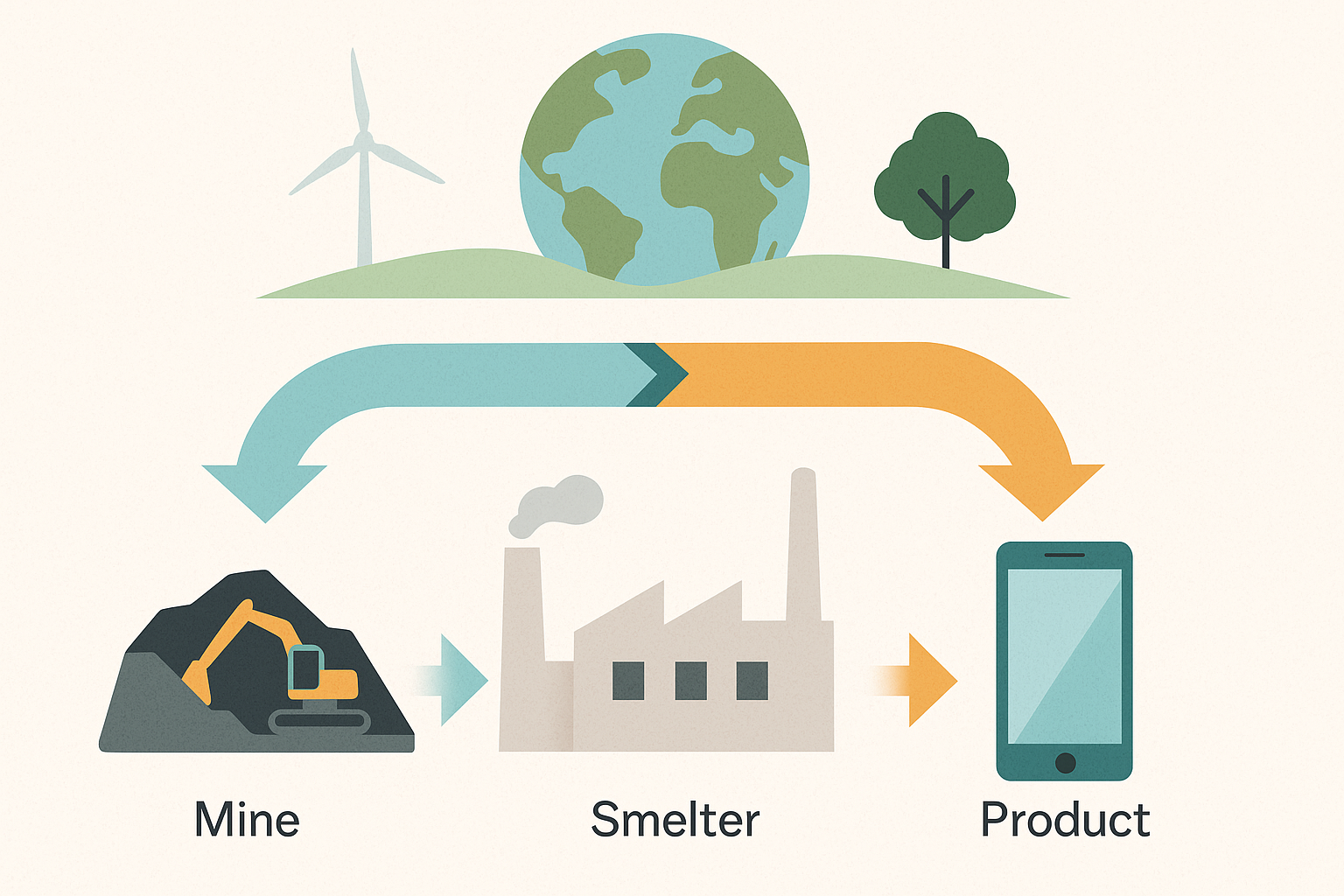
The answer lies in a chain of custody. IRMA’s Chain of Custody (CoC) Standard, launched in 2024, is designed to carry trust beyond the mine and into the complex networks of processors, refiners, manufacturers, and brands.

Why Chain of Custody Is Essential

Once minerals leave the mine, they often enter global systems where materials are blended, transformed, or routed through multiple facilities. A CoC standard closes this gap by enabling companies to make verifiable sourcing claims linked directly to IRMA-audited mines. As transparency becomes a regulatory expectation and a growing consumer demand, this link is more important than ever.

New EU rules, including the Critical Raw Materials Act and the 2025 mineral-supply-chain transparency platform, signal that traceability is rapidly shifting from a voluntary gesture to a regulatory requirement. Companies importing or using critical minerals will increasingly need credible systems to demonstrate where materials come from and how they manage associated risks.

Recent New York Times reporting also highlights the human cost of opaque supply chains, documenting how recycled battery lead has poisoned communities. It is a stark reminder that reliable chain-of-custody systems like IRMA’s are no longer optional but essential.

A Step Toward More Transparent Minerals

The IRMA CoC Standard outlines five models, a flexible structure that meets companies where they are while maintaining transparency and credibility:

Identity Preserved: Minerals stay physically separate and traceable from mine to final product.

Segregated: IRMA-assured materials from different mines can be mixed, but never combined with non-assured material.

Controlled Blending: Allows mixing with non-assured material while maintaining clear controls and limits.

Mass Balance: Tracks inputs and outputs over time, offering flexibility where physical separation is not possible.

Book & Claim: A credit-based model enabling support for responsible mining even when physical traceability is highly complex.

Together, these models give companies flexibility in how they track materials, and the pilots now underway are helping IRMA understand which approaches work best across different supply-chain contexts.

Next Steps for IRMA

IRMA has developed and published the Chain of Custody Standard, including guidance on assurance and on how the IRMA seal enables credible, transparent claims about responsibly sourced materials. Building on this foundation, IRMA has launched pilots across different mineral sectors and industries to test how the CoC models work in practice and what companies need for effective implementation. As these pilots progress, IRMA is now working to formalize the resulting data into a materials registry that will allow participating companies to make verified chain-of-custody claims with confidence.

Piloting the CoC Standard with mining companies, processors, and downstream buyers to test feasibility across different supply-chain contexts.

Integrating feedback from pilot participants, auditors, and technical experts to strengthen clarity and usability.

Creating tools and templates that support consistent data collection and transparent sourcing claims.

The chain of custody alone cannot solve every supply-chain challenge. But it plays a crucial role in linking responsible mining practices with the products people rely on every day. It supports stronger procurement decisions, clearer consumer communication, and more consistent accountability across the value chain. These efforts mark real progress toward knowing where your phone battery comes from—from mine to market, and source to store.

If your company would like to join the brands already piloting the IRMA CoC Standard and explore how it could work in your supply chain, I’d welcome a conversation! Feel free to reach out.


coc@responsiblemining.net

READ MORE
Complaints

Complaints and the IRMA System

This week IRMA posted the first complaints being processed through the IRMA Issues Resolution System. One (IRMA-2024-001) filed by the SIRGE Coalition (Securing Indigenous Peoples’ Rights In The Green Economy), and another (IRMA-2024-002) by the environmental advocacy NGO (and IRMA Board Member) Earthworks, both complaints question how the audit firm ERM CVS assessed the conformity of Albemarle’s Salar de Atacama lithium operation in northern Chile with IRMA’s Free Prior and Informed Consent (FPIC) requirements, and how evidence was weighed and assessed in reaching audit findings.

Although the larger goal is to make mining more responsible – overall and particularly at IRMA audited mines – the means to do that is by providing unprecedented transparency to all stakeholders so that they can open dialogues that incentivize better operational practices. These complaints are exactly that: stakeholders using the information provided by IRMA audits to examine a mine’s practices and ask why they were measured as they were.

It’s important to note that all actors directly or indirectly associated with these complaints are learning how to do their work better. Although the IRMA Standard has been around since 2018, the Albemarle operation was the first lithium operation audited against the Standard, and just the third mine audited overall. The audit firm, the mining company, and IRMA itself are learning how to the IRMA system works in practice and how we can improve it.

In the near future, IRMA and the audit firm will meet, after which point we will get back to the complainants with next steps. As we process these complaints we will update their pages to keep stakeholders current about how the Issues Resolution System is working, and to allow the opportunity for all concerned to keep IRMA true to our core principles.

READ MORE
Credit: Picryl.com under the Creative Commons licenseCredit: Picryl.com under the Creative Commons licenseAssurance

Why IRMA doesn’t use the word ‘certified’

You may have noticed that IRMA no longer uses* the words certification or certified in its programs and materials.  Instead, we refer to independent assessment and IRMA achievement (e.g. IRMA 75).

This is intentional.

In our view, “certification” conveys the certifying institution’s approval of the audited company, site or product. Many view certification labels as intended to assure the buyer or end-consumer that they’re buying something which has been approved.

While this approach is simple to understand, widely used, and has a long history in the marketplace, we believe it’s not an appropriate approach for the complexity of mining operations and the scale of industrial mining’s impacts. Certification, in the sense that it signifies approval, often means vastly different things to those impacted by mining—whether mine management, mine workers, customers of mines, or communities living near mines.

Instead, we use a scoring tool to:

  • measure performance against a shared definition of best practices in mining;
  • create incentive for more transparent accounting of impacts and achievements;
  • welcome any operation, at any stage of their journey, to feel they can use the IRMA system to guide changes;
  • build value for continuing improvement; and
  • allow each stakeholder to make their own judgement about what the mine’s independently assessed performance against the IRMA Standard (its scoring as revealed in an IRMA audit report) means, instead of providing a proverbial stamp of approval.

An IRMA audit report offers readers not only an overall achievement level (IRMA Transparency, IRMA 50, IRMA 75, or IRMA 100; explained below) , but also provides scores for hundreds of requirements including the auditor’s rationale for assigning that score. This level of detail is key to:

  • ensure the audit reports can be used as a centerpiece for meaningful conversations, whether between communities and the mine, a mine’s customer and mine management, or any other constellation of interested parties; and
  • guide the mine on specific actions they can take to meet practice in the weeks, months and years ahead.

Because we know that some readers won’t study performance on each requirement and instead want a quick summary of performance we offer an overall achievement score.

  • IRMA Transparency is given to a mine site that is audited against the IRMA Standard, releases the subsequent audit report publicly, and doesn’t reach a higher achievement level.
  • IRMA 50 and IRMA 75 are achieved when a mine meets at least 50% or 75% average of the possible scores in each of the four main principles of the IRMA Standard (environmental, social, business integrity, and leaving positive legacies). In other words, a mine can’t score 100% in social chapters and 0% in environmental chapters and be IRMA 50; they need to achieve at least 50% average in each of the four principles.
  • Mines achieving IRMA 50 and above must also at least substantially meet 40 of the IRMA Standards requirements that are designated as critical. This helps to ensure that as we share these milestones of achievement in working toward best practices, sites with achievement levels don’t have significant issues like child labor or human rights abuses.
  • An IRMA 100 mine follows all aspects of the IRMA Standard. Even at this level, IRMA doesn’t say the mine is “certified”, but provides the information stakeholders need to draw their own conclusions about the mine’s performance and impacts.

It is important to note that IRMA 100 originally signaled “IRMA certification” – and was written directly into specific points of the 2018 IRMA Standard for Responsible Mining. For example

2.2.2.2. “New mines shall not be certified [achieve IRMA 100] by IRMA unless they have obtained the free, prior and informed consent (FPIC) of potentially affected indigenous peoples.”

The 2024 update to the Standard will remove these “certification” references. It is further important to note that “certification” is this example is not equated with “assessed.” A mine can be assessed in IRMA, even if it has not obtained FPIC. The resulting scores will simply relay the details around this important aspect of a mine’s operations.

We continue to look for ways to evolve IRMA’s scoring system to provide clear and meaningful data on performance without oversimplifying the important details or risks.


* Although references to “certification” have been removed from IRMA website text (e.g. the Assessment page used to be the Certification page), the process is still underway for PDF documents.

READ MORE
Introduction to the IRMA Audit Firm Approval Process - thumbnailIntroduction to the IRMA Audit Firm Approval Process - thumbnailAssurance

Introduction to the IRMA Audit Firm Approval Process

Co-hosted by IRMA Assurance Services International (ASI), held a meeting introducing the IRMA audit firm approval process, and how IRMA oversees its approved audit firms. The meeting recording and slides are below.

Development of robust standards are only one half of the IRMA system. Just as important to our mission is the work of highly competent and accountable audit firms to measure mine performance against those standards. 100+ mines owned by 75+ companies are engaged in the IRMA system. We are bringing on additional audit firms in response to increasing demand for IRMA audits.

More resources for audit firms are available on the Resources page.


Slides from the presentation

READ MORE
Sewell, Chile Attribution: Hiroki OgawaSewell, Chile Attribution: Hiroki OgawaAudits

IRMA response to civil society groups’ greenwashing concerns

1 Oct note: this blog has been edited since it was originally published to add IRMA’s position on “certification” and to increase clarity

An acknowledgment

IRMA acknowledges the continuing frustrations and important concerns raised in a statement by a network of civil society groups in relation to voluntary initiatives and certification systems, and specifically critique of the IRMA Standard for Responsible Mining and its associated independent audit system. We hear loud and clear their concerns that the Standard’s verification and achievement levels, and even participating in the audit process, could enable what some affected communities see as “greenwashing” the impacts of large-scale extraction. While we respond here to the concerns raised, we will respect request of groups in this network to not be named in our response.

IRMA’s Standards seek to reflect the perspectives of all stakeholders and Indigenous rightsholders using an equal, multi-stakeholder governance model. We actively seek out and encourage diverse perspectives from civil society actors as evident through the composition of working groups that aim to ensure that IRMA equally represents all concerned with the impacts of mining and the need to reduce harm. Some in civil society will find use in IRMA’s tools to make mining projects better, reducing negative impacts and increasing benefit sharing, others may reference IRMA’s definition of best practices when resisting mining in a place where Indigenous rights holders and others affected believe the risks and losses are too great. IRMA’s Standards reflect the principles of international conventions such as ILO 169 and the United Nations Decrlation on the Rights of Indigenous Peoples, and also the International Finance Corporation’s expectations that companies demonstrate they have achieved “broad community support” where they do business.

Not a replacement for government oversight

IRMA is a voluntary initiative intended to be used as a tool to offer transparency and accessibility to independently verified information of a mine site’s performance. It is not intended to replace or interfere with government oversight. We agree that no voluntary initiative has enforcement power to hold mining companies financially or legally accountable for infractions. IRMA’s independent audits are meant to provide unprecedented transparency and information about individual mining operations that affected stakeholders and rightsholders can use to demand better mining practices. This also offers opportunity for diverse sectors to differentiate and create greater value for mining companies who reduce harm, increasingly adopt best practices and more equitably share benefits with host communities.

IRMA doesn’t certify

It is important to note that IRMA is not a “certification” system. Although many voluntary standard systems do assign a stamp of approval, IRMA does not. We create and maintain a best-practice mining Standard, and through independent auditing, we report how a mining operation performs against that Standard. An IRMA 50 or 75 isn’t a stamp of approval. Rather, it’s insight into how an independent audit firm decided that the mine scored no lower than either 50% or 75% in the 4 IRMA principles: environmental and social responsibility, business integrity, and leaving positive legacies. Information is power, and power to positively change how mining is done. IRMA is dedicated to ensuring all those affected by mining have the information they need to make informed decisions about the mining that affects them.

Funding

Many voluntary standard systems related to mining are governed and primarily funded by private entities or industry trade associations. Civil society organizations have expressed concern that the motives of mining trade associations may appear in conflict with those whose highest priority is avoiding or minimizing mining’s negative impacts. We seek opportunities to collaborate with mining trade associations as they offer powerful potential to support their members to improve practices – and IRMA will maintain its fundamental commitment to equal governance by affected communities, labor unions, and NGOs working alongside private sector leaders. IRMA’s funding structure does include income from private sector membership fees and special project grants. However, over 50% of our funding is from philanthropic organizations that are passionate about climate justice and an equitable energy transition, including but not limited to the Ford Foundation, Climateworks Foundation, 11th Hour Project and Waverley Street Foundation.

Audits and audit firms

The network’s statement criticizes voluntary initiatives for not requiring surprise/unscheduled audits, expressing concern that mine sites can prepare in advance to clean-up or hide negative aspects of their operations. Auditor firms trained and approved by IRMA conduct an extensive review of documentation (including but not limited to records of site photos and digital files) to make informed decisions regarding compliance with standard requirements. IRMA is the only mining standard that requires public notice of audits before they begin – so that any Indigenous rights holder or other stakeholder may have direct access to auditors, to share their perspectives and concerns. Auditors reach out to stakeholders though various means to hear diverse perspectives, including online comment forms and social media (including WhatsApp), radio announcements, flyers and word of mouth individual outreach. IRMA staff also work to spread the word, including in-person conversations with workers, local community members, and NGO allied organizations.

IRMA acknowledges and shares the concerns regarding the expertise and impartiality of auditors and the auditing companies that employ them. As mentioned in the network’s statement, the reality is that most auditors for the mining sector, to date, have historically been accustomed to assessing mine sites against industry-led initiatives and standards. Affiliates of auditing companies have at times also served mining company clients either directly or indirectly through other means such as technical consulting services. IRMA requires its approved audit firms to follow conflict of interest rules, meet technical and expertise criteria, and draft audit reports are reviewed by IRMA’s Director of Assurance prior to finalization. The first 15 initial audits against the IRMA Standard for Responsible Mining have served and are serving both the IRMA Secretariat and Board, and the audit firms with whom we work, an opportunity to listen, learn and identify ways to improve the process for training of auditors, clarifying requirements in the Standard and improving civil society engagement in the audit process.

Improvement is for IRMA too, not just mining operations

The IRMA Secretariat and Board of Directors appreciate the recommendations from organizations that are critical of voluntary initiatives, and we commit to a practice of continually improving the IRMA system to build the trust, value and confidence for everyone who uses the system. IRMA is currently in the process of acting on civil society recommendations to improve methods for communicating audit report results and accessibility to IRMA’s Issues Resolution System.

IRMA’s approach to supporting more responsible mining encompasses the need to have mining operations be measured against best practices as assessed through the 400+ requirements of the standard. By supporting civil society participation in audits, we work to amplify the right of Indigenous rights holders and other stakeholders who say “No” to a mining operation, and to those who seek reduction of harm, increased access to information, improved benefits sharing and elevating their perspectives at an international level. IRMA firmly believes that through constructive dialogue with all IRMA can be a tool that encourages change that is equitable and inclusive of all perspectives in relation to mining.

READ MORE
IRMA board and staff in 2019IRMA board and staff in 2019Blog

IRMA is hiring: Standards Director & Mining Engagement Lead

As interest and engagement in IRMA continues to grow, we are now seeking new staff.

Standards Director

The Standards Director will focus on and oversee the development of IRMA’s standards, including managing public consultation processes on new standards and revisions of existing standards, overseeing expert working groups, and developing and updating standard guidance.

The successful candidate will work closely with IRMA’s Executive Director, IRMA’s Assurance Director, and IRMA’s Senior Policy Advisor.

Read the whole description including salary, and apply at Acre.

Mining Engagement Lead

The Mining Engagement Lead will support mining companies to find value for their engagement with IRMA; guide them to use the IRMA Standard and system to improve mines’ social and environmental performance; and develop tools, materials, and interactive sessions to engage and educate mining sector stakeholders.

The successful candidate will work closely with the Deputy Director, Executive Director and the team of sector and regional leads.

Read the whole description including salary, and apply at Acre.

READ MORE
Assurance

IRMA seeks audit firms

IRMA is growing as more companies commit to third-party audits that independently assess their mining-related operations against the IRMA Standard for Responsible Mining. To accommodate this growth, IRMA is seeking to expand the number of audit firms (certification bodies) that provide independent audits against the IRMA Standard in line with IRMA assurance requirements.

Interested bodies may apply anytime to become approved. IRMA has partnered with Assurance Services International (ASI) to manage the approval process, oversee performance of approved bodies and to formalize its oversight program more generally. The approval process includes a remote document review and a head office assessment against IRMA requirements.

Following approval, ASI will witness a sample of on-site mine site audits and carry out head office surveillance assessments. The IRMA Secretariat will compile regular performance reviews to ensure approved audit firms meet the defined expectations.

We are grateful to IRMA’s inaugural audit program partners — SCS Global Services and ERM Certification and Verification Services — as we expand our capacity.

To apply, and get more information on the approval process and the underlying requirements, visit the IRMA website under Auditor Resources

READ MORE

Updated financial assurance guidance

In response to practical difficulties obtaining financial surety for mine closure and post closure as defined by the IRMA Standard, IRMA has modified 2.6.4.1 which is a critical requirement in the IRMA standard and must be substantially or fully met in order to achieve IRMA 50 or higher.

With this modification, the requirement for “financial surety instruments” — which by definition exclude corporate guarantees and self-bonding — is replaced with “financial assurance mechanisms.” This allows a broader range of acceptable means to guarantee the costs associated with third-part mine closure and post-closure.

The IRMA Secretariat made this change with the concurrence of the IRMA Board and external expert feedback. This is a temporary adaptation that will be reconsidered in the planned revision of the IRMA Standard expected in late 2023.

The background and challenges for this temporary modification and our plan going forward are presented in this guidance document, along with specific details on how this modification is to be interpreted by mine sites, independent auditors, and other interested stakeholders.

READ MORE
Carrizal home pageCarrizal home pageAudits

Carrizal Mine Surveillance Assessment Update

The Initiative for Responsible Mining Assurance (IRMA) is pleased to announce the upcoming third-party independent surveillance assessment of the Carrizal Mine against the IRMA Standard for Responsible Mining. The Carrizal Mine is located near Zimapan in the Hidalgo province of Mexico. The on-site portion of the surveillance audit will occur 24-27 August 2022.

What is a Surveillance Audit?

A surveillance audit is a mid-cycle verification to ensure no material negative changes have occurred at a site. It is not a re-assessment of all IRMA requirements. Surveillance audits follow much of the same process as a certification audit and include document review, on site-assessment, and community and stakeholder engagement. An IRMA surveillance audit confirms continued performance against critical requirements, verifies ongoing regulatory compliance processes, and evaluates progress on corrective actions. It also follows up on stakeholder input received since the prior audit and areas of risk identified in the previous audit and confirms no major changes have occurred that would impact the previously assessed achievement level.

ERM CVS is the IRMA-approved certification body carrying out the surveillance assessment.

Stakeholder Engagement in the Assessment

Interested stakeholders and members of the public can sign up to receive updates about the Carrizal mine assessment. The Mines Under Assessment page of IRMA’s website will also provide up-to-date information on all assessments.

Mine site stakeholders are invited to submit comments to ERM CVS on the social and environmental performance of the Carrizal Mine (in particular, how the mine measures against the IRMA Standard for Responsible Mining).

Carrizal Mine stakeholders may also contact ERM CVS if they are interested in being interviewed as part of the assessment process or being notified of the publication of the public report.

Stakeholder comments and expressions of interest in being interviewed as part of the audit process should be submitted by email to post@ermcvs.com.

Email: visit the ERM CVS website for this information and more on the audit.

Please forward this announcement, and feel free to contact ERM CVS directly to provide names and contact information for other mine site stakeholders who may be interested in knowing about and participating in the mine site assessment process.

For more information

READ MORE