
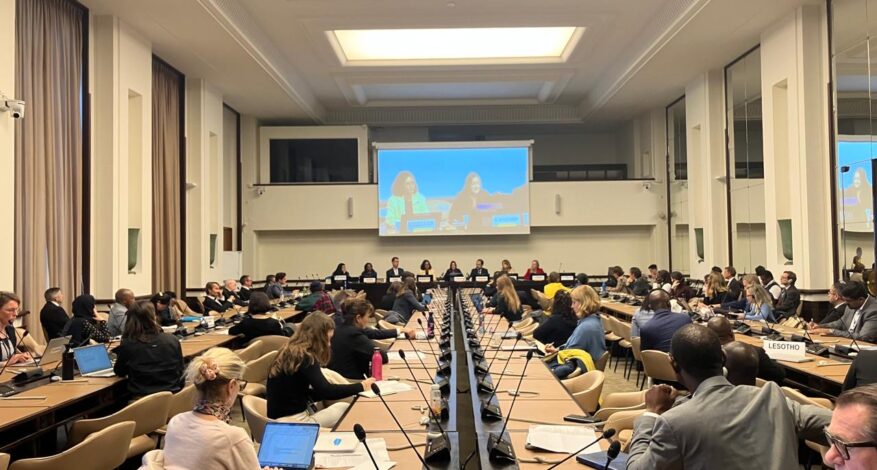
IRMA Engagement at IGF Annual General Meeting
This November IRMA participated in the Intergovernmental Forum on Mining, Minerals, Metals, and Sustainable Development (IGF) 21st Annual General Meeting (AGM) at the Palais des Nations in Geneva. IGF’s 86 Member Countries met with participants from around the world to discuss “Value Beyond Extraction: Rethinking Mining for a Resilient Future.”
The IGF AGM offers an opportunity for IRMA to gather with IRMA Members and AGM participants from around the globe and to contribute to discussions on key topics. This year IRMA’s contribution to the IGF AGM focused on organizing and co-facilitating a Partner-led Side Session with the UN Environment Programme (UNEP).
The UNEP-IRMA Side Session “Strategies for Strengthening Traceability and Circularity,” provided an overview of emerging strategies and partnerships for traceability and circularity, emphasizing opportunities to advance the General Principles and Actionable Recommendations from the UN Secretary-General’s Panel on Critical Energy Transition Minerals. The session outlined UNEP’s work on traceability and circularity, including the implementation of the UN Environment Assembly (UNEA) 6/5 Resolution on environmental aspects of minerals and metals; strategies from the African Union, G7, and G20; examples of approaches of voluntary standards; and a discussion of opportunities to build coherence to amplify positive impacts.
UNEP’s Charlotte Ndakorerwa opened the session with a summary of the UNEA Resolution 6/5, including development of a knowledge hub, and Colombia’s resolution for UNEA-7 on traceability and other aspects of minerals and metals. IRMA’s Law and Policy Director, Kristi Disney Bruckner, provided a brief overview of IRMA and examples of the many new initiatives in development, including the Future Minerals Forum Sustainability Framework, the UN Industrial Development Organization (UNIDO) Global Alliance for Responsible and Green Minerals, the G7 Critical Minerals Action Plan and recently launched Roadmap, International Organization for Standardization (ISO) standards development, emerging national standards, and others. “This is an opportunity moment to build partnerships and coherence to amplify the positive impacts of these initiatives,” she said, “including to advance the UN Secretary-General’s Panel on Critical Energy Transition Minerals Guiding Principles and Actionable Recommendations.”
Marit Kitaw of the UN Economic Commission for Africa (UNECA) and Former Interim Director of the African Minerals Development Centre (AMDC) provided an overview of the African Union’s Green Minerals Strategy. The strategy aims to retain value that historically has been lost with exports, focusing on infrastructure, skills, technology, sustainability, value addition, and governance. “We need win-win partnerships,” Marit said, noting that Africa is endowed with over 30% of the world’s critical minerals. “Win-win means for everyone.”
Parliamentarian Cecilia Nicolini, Former National Environment Secretary of Argentina, leading energy transition minerals discussions in Argentina and in MERCOSUR, shared development of a MERCOSUR Regional Strategic Minerals Plan, noting the need for regulatory harmonization and strengthening South-South relationships. “We can be more competitive in a sustainable world,” she said, with “a common voice in the international arena.”
Rodrigo Urquiza Caroca of Chile’s Ministry of Mining discussed Chile’s national strategies for energy transition minerals. Chile has built experience over more than 100 years, learning to balance environmental, social, and economic impacts and implement the International Labour Organization Indigenous and Tribal Peoples Convention (ILO 169). Over 14 meetings with communities over two years informed Chile’s National Lithium Strategy. The country is also learning from its relationships and agreements with bordering countries.
The panel also discussed the work of the G7. Daniel Hill, Deputy Director of Natural Resources Canada, provided an overview of the G7 Critical Minerals Action Plan and Roadmap noting efforts on traceability, transparency, investment resiliency, innovation, anti-corruption, and performance-based criteria.
The work of civil society organizations is essential to inform and guide development of emerging frameworks. Erica Westenberg, Governance Programs Director at the Natural Resource Governance Institute (NRGI), shared experience collaborating with civil society to advance the objectives of the UN Secretary-General’s Panel on Critical Energy Transition Minerals. Erica noted that the UN Framework Convention on Climate Change has been silent on critical minerals and NRGI is working with others to change this to increase equity and justice in the minerals sector. Erica also discussed Colombia’s UNEA-7 resolution on minerals and metals, covering traceability and other topics that aim to advance the work of the UN Secretary-General’s Panel. In her remarks, Erica launched the Expert Group on Preventing Corruption in Transition Minerals report “From Mine to Market: Using Traceability to Fight Mineral Sector Corruption,” noting contributions from IRMA.
Inga Petersen, Executive Director of the Global Battery Alliance, shared GBA’s commitment to a multistakeholder approach to enhance traceability and circularity. “We need collaboration, now more than ever,” she said, noting that even with full recycling of batteries we will have more mining and need to scale social and environmental protections. “We need transparency to understand risks along the value chain,” she said, and “it can only be meaningful if it comes with accountability.” Inga shared an overview of GBA’s recently released Battery Benchmarks, inviting collaboration.
Discussion focused on the need to focus not only on producing countries but also on consumers to ask about responsible sourcing. Participants further discussed traceability, noting that while there is much progress to be made, this has been done in other high-risk and high-reward sectors, and we can learn from these efforts. The discussion also identified opportunities to focus more on value addition, end use of materials, and circularity.
Charlotte concluded the session, noting themes that emerged from the panel and discussion. “There is a need for alignment and interoperability,” she said. “We really need more partnership and collaboration at global and regional levels that are win-win.”
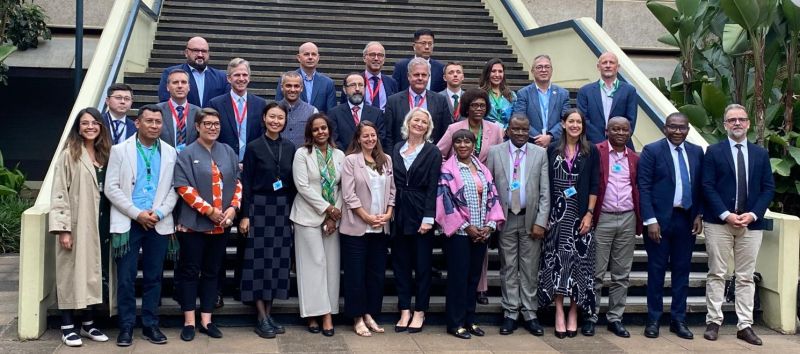
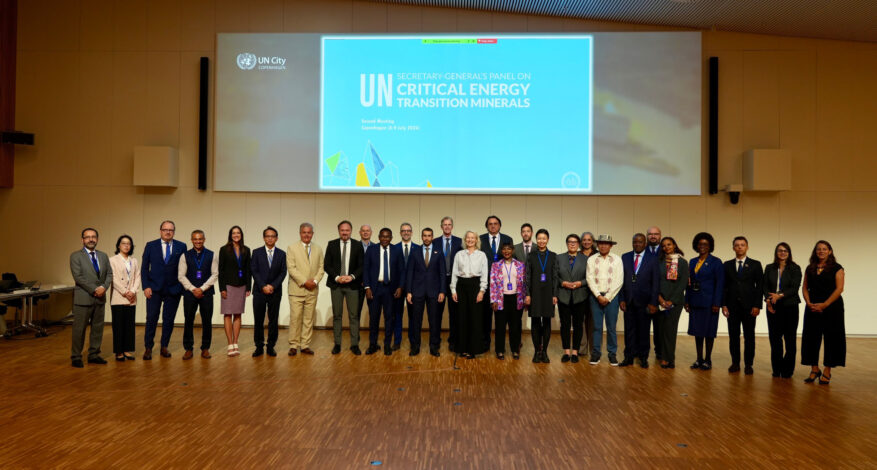
 Input Requested by 30 July to Inform the UN Secretary-General’s Panel on Critical Energy Transition Minerals