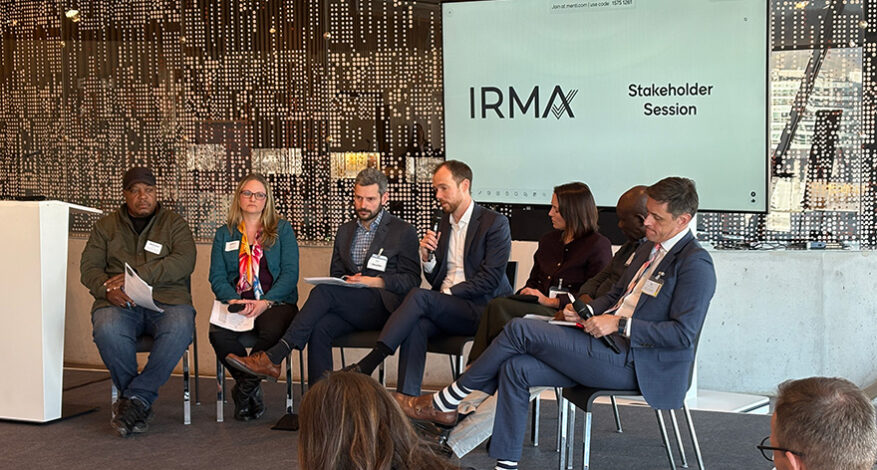
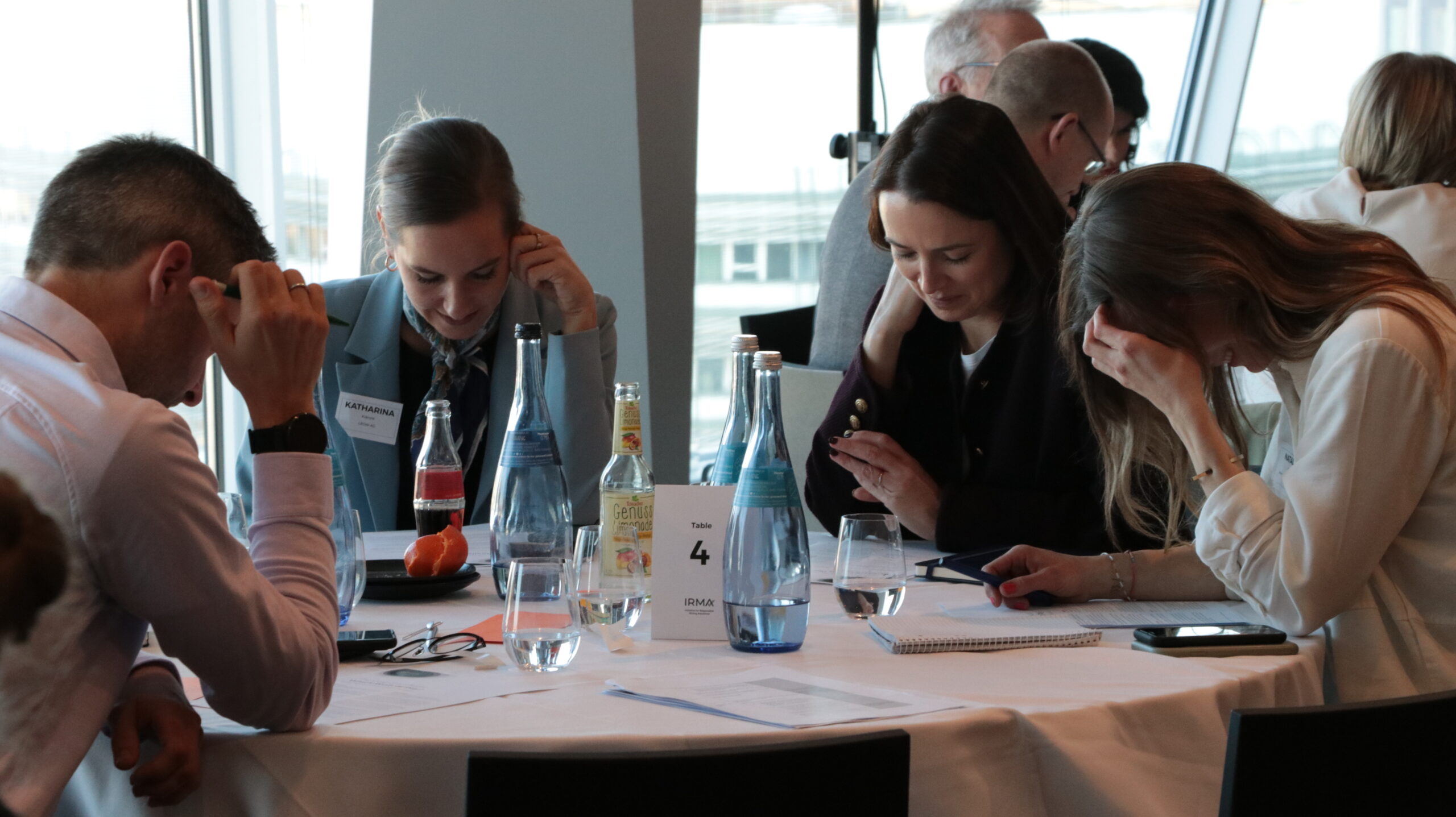
As part of IRMA’s annual in-person board meeting hosted by Mercedes-Benz in early March, IRMA convened a dialogue between 80+ attendees to better understand how they can work together and also use the IRMA system to achieve their diverse goals.
For a full afternoon, attendees exchanged learnings and ideas about how to grapple with ever-present questions about transparency, traceability, and the cost of responsible mining, all with the aim of hearing from each other and taking back fresh ideas on how to inform their own work.
The dialogue occurred in two parts. To begin, IRMA Board members representing our six governing houses – Meshack Mbangula from Mining Affected Communities United in Action in South Africa, Glen Mpufane from IndustriALL Global Union, Jim Wormington from Human Rights Watch, Johannes Danz from Mercedes, Katie Fergusson from Anglo American, and Ashley Claxton from Royal London Asset Management – each how they have used an IRMA audit to advance their organizations’ goals.
After that all attendees divided into nine groups to discuss one of three issues:
Is there such a thing as too much transparency? Although transparency benefits all stakeholders, it can also bring heightened scrutiny and criticism for mines, consumer-facing brands, and investors. What do diverse stakeholders most need when it comes to valuing transparency?
What do diverse stakeholders most need when it comes to market signals and traceability given the indirect contact between the many upstream and downstream players in the mineral supply chain?
What’s really at play when it comes to the cost of an IRMA audit? Stakeholders find audit cost concerns are more related to the cost of improvements that result from an IRMA audit’s transparency, rather than the audit itself. How can stakeholders signal the value of an audit?
Some of the discussion results:
For mines, IRMA audits and the audit process provide a clear roadmap and driver toward operational excellence. The audit is as much for a mine’s own operational and strategic benefit as it is for anybody else’s.
For impacted communities, nothing about us without us. The *process* of the IRMA audit provides as much or more value to communities as the audit itself. It provides an opportunity for inclusiveness, fairness, dignity, and importantly, a voice.
As demand for mining rapidly increases, so too does the need for capital to finance it. For investors, IRMA audits provide the necessary visibility and assurance to credibly understand an investment’s risk profile and suitability for investment, thus providing a clearer path to enabling that access to capital.
The ability to catalyze candid discussion amongst wary stakeholders is one of the benefits of IRMA’s governance model, the only place in modern industrial mining where civil society has equal power and voice to the private sector.
Consistent with the IRMA Standard, the statement calls for upstream suppliers to commit to the adoption of free, prior and informed consent (FPIC), independent third-party auditing, multi-stakeholder consultations, fair compensation to affected rights-holders, effective grievance procedures and a commitment to report publicly on the implementation of these actions.
The list of signatories includes pension funds and asset managers well-recognized in the sustainable investing space including PGGM, Storebrand, and Triodos Investment Management.
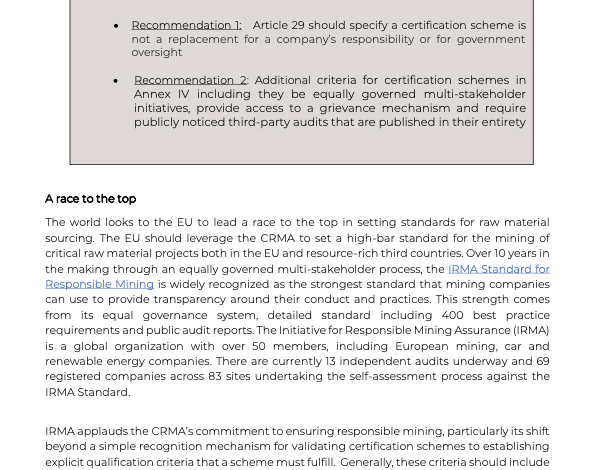
Article 29 should specify a certification scheme is not a replacement for a company’s responsibility or for government oversight
Additional criteria for certification schemes in Annex IV including they be equally governed multi-stakeholder initiatives, provide access to a grievance mechanism and require publicly noticed third-party audits that are published in their entirety
Public Information, Rm. 6808
Bureau of Public Affairs
U.S. Department of State
Washington, D.C. 20520-6810 AskPublicAffairs@state.gov
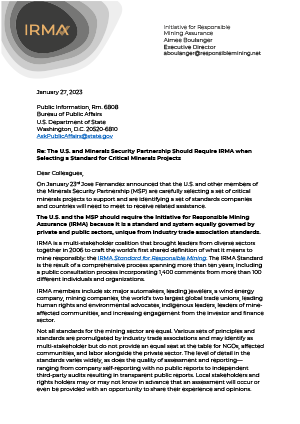
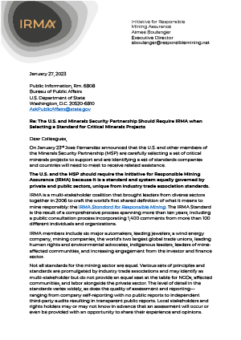
Re: The U.S. and Minerals Security Partnership Should Require IRMA when Selecting a Standard for Critical Minerals Projects
Dear Colleagues,
On January 23rd Jose Fernandez announced that the U.S. and other members of the Minerals Security Partnership (MSP) are carefully selecting a set of critical minerals projects to support and are identifying a set of standards companies and countries will need to meet to receive related assistance.
The U.S. and the MSP should require the Initiative for Responsible Mining Assurance (IRMA) because it is a standard and system equally governed by private and public sectors, unique from industry trade association standards.
IRMA is a multi-stakeholder coalition that brought leaders from diverse sectors together in 2006 to craft the world’s first shared definition of what it means to mine responsibly: the IRMA Standard for Responsible Mining. The IRMA Standard is the result of a comprehensive process spanning more than ten years, including a public consultation process incorporating 1,400 comments from more than 100 different individuals and organizations.
IRMA members include six major automakers, leading jewelers, a wind energy company, mining companies, the world’s two largest global trade unions, leading human rights and environmental advocates, indigenous leaders, leaders of mine-affected communities, and increasing engagement from the investor and finance sector.
Not all standards for the mining sector are equal. Various sets of principles and standards are promulgated by industry trade associations and may identify as multi-stakeholder but do not provide an equal seat at the table for NGOs, affected communities, and labor alongside the private sector. The level of detail in the standards varies widely, as does the quality of assessment and reporting—ranging from company self-reporting with no public reports to independent third-party audits resulting in transparent public reports. Local stakeholders and rights holders may or may not know in advance that an assessment will occur or even be provided with an opportunity to share their experience and opinions.
IRMA stands out from industry trade association standards because it is recognized across stakeholder sectors and has already been recognized by multiple MSP members. The United Kingdom’s 2022 Critical Minerals Strategy references IRMA as a globally recognized framework for responsible mining.[1] In 2021, the White House referenced IRMA in its 100-Day Review on Building Resilient Supply Chains, noting that IRMA is a possible “method for U.S. companies and the Federal Government to ensure that minerals are being sourced from mines with robust environmental, social, and financial responsibility practices.”[2] The European Parliament referenced the IRMA Standard in its 2021 strategy for critical raw materials.[3] The Government of Australia called IRMA a “no regrets approach” in its 2020 study of certifications and strategies to increase competitiveness of Australian battery materials for use in the EV sector in Europe.[4]
IRMA is the only standard for the mining sector that fully embodies the Biden Administration’s environmental justice goals. This is because IRMA is the only standard for the mining sector that:
is equally governed by directly affected communities, NGOs, labor unions, mining companies, purchasing companies, and the investor and finance sector;
requires public notice in advance of an audit so that local stakeholders and rights holders can prepare to engage in the audit;
is applicable globally and covers all mined materials (apart from thermal coal, uranium, and deep seabed mining projects);
includes the full range of environmental and social issues related to industrial-scale mines;
requires detailed public reports made available at no cost to the public, with scoring and rationale on over 26 topics across over 400 requirements; and
has demonstrated credibility with civil society and labor unions.
IRMA is built on best practice norms. Existing international systems and frameworks form the basis of requirements in the IRMA Standard and are assessed in IRMA audits. These include but are not limited to the Extractive Industries Transparency Initiative (EITI), the International Cyanide Management Code, International Finance Corporation (IFC) Performance Standards, International Labour Organization Conventions, International Union for Conservation of Nature (IUCN) Protected Area Management Categories, the Minamata Convention on Mercury, OECD Due Diligence Guidance, UNESCO Biosphere Reserves, the United Nations Guiding Principles on Business and Human Rights, and the Voluntary Principles on Security and Human Rights.
IRMA requires completion of an independent third-party audit before any public claims may be made related to IRMA achievement. The IRMA system enables companies to clearly communicate their performance across a holistic set of best practices and work toward continuous improvement in environmental and social responsibility.
IRMA’s equal governance model upholds a standard and system that creates confidence and value across all stakeholder sectors and greater trust across supply chains. The U.S. and MSP should support and incentivize the IRMA Standard and system because of its unique accountability to all sectors and alignment with the MSP’s commitment to “adhere to the highest environmental, social, and governance standards.”[5]
[4] UTS Institute for Sustainable Futures and the University of Melbourne, Certification and LCA of Australian Batter Materials – Drivers and Options: Scene Setting Project Prepared for Future Battery Industries CRC, Future Battery Industries CRC, Australian Government Department of Industry, Innovation and Science Business Cooperative Research Centres Program, August 2020, https://fbicrc.com.au/wp-content/uploads/2020/10/Certification-of-Au-Battery-Materials-WEB-INTERACTIVE-SEPT-2020.pdf.
IRMA is deeply concerned with the terrible conflict in Ukraine. As we have both private sector and civil society organizations working with IRMA in the region, we have spent the last week reaching out to our participants, other multi-stakeholder standards systems, and experts in auditing. We welcome feedback from any stakeholder on our course of action.
IRMA civil society organizations focused on Russia, working for greater environmental and social responsibility in mining, are encouraged to continue to engage in IRMA.
Private sector purchasers and investors with concern for more responsible practices may continue to ask mining companies in Russia to measure their performance against the IRMA Standard.
For mining companies based in Russia, all effort at this time must be with the IRMA Mine Measure self-assessment tool, which can guide them on areas that may need improvements to protect social and environmental values. No external claims of IRMA achievement by companies using the tool will be allowed in the market. No mining companies in Russia have yet been independently audited against the IRMA Standard. We will not commence auditing in the region until there is greater stability and confidence that diverse stakeholders may safely engage in a robust independent audit. Additionally, a decision has been made to pause membership activities for Russian-based mining companies at this time.
We join the global community in heartache for the suffering at this time of violent conflict there and in other places around the world. We affirm IRMA’s core vision regardless of the geography: a world where the mining industry respects the human rights and aspirations of affected communities, provides safe, healthy and supportive workplaces, minimizes harm to the environment, and leaves positive legacies.
Our position is an initial response and will evolve as appropriate with global circumstances and we welcome your feedback at info@responsiblemining.net.
UPDATE: 21 March 2022
Nornickel Statement
Nornickel is a Russia-based mining company that had pending membership status in IRMA and, as a result, was preparing for independent audit. IRMA has encouraged the company to continue to use the self-assessment tool to understand IRMA requirements and to seek opportunities for improved performance, and we hope to engage in an independent audit in the future. The company has shared with IRMA the following statement:
Nornickel has agreed to pause its pending membership status in IRMA, and will continue to work independently and will continue to use the IRMA Mine Measure self-assessment tool to prepare for independent audit to improve practices that reduce environmental and social impacts. We believe that the findings from this informal exercise will make a useful guide on how we can improve towards IRMA standards, while we are held on pause.
Batani Statement
Batani (International Indigenous Fund for development and solidarity) is a non-governmental organization and an IRMA Member. They have shared with IRMA the following statement:
Batani stands in solidarity with the people of Ukraine in their struggle for freedom, and we are extremely concerned about ensuring the rights of Indigenous peoples during the war on Ukrainian territory. This war has also created security issues for indigenous peoples living in Russia. As a result, Batani appreciates the steps IRMA has taken to pause the Nornickel audit until it can be done in a manner that ensures the safe engagement of communities affected by the Nornickel operations.
BMW Group has become the first carmaker to join the global effort for the third-party certification of social and environmental performance at mine sites.
“Sustainability is an important aspect of our corporate strategy and we are fully aware of our responsibility in mineral value chains.” said Dr. Andreas Wendt, member of the board of management of BMW AG responsible for Purchasing and Supplier Network. “For the BMW Group and its stakeholders, it is of the utmost importance that environmental and social standards are adhered to throughout the entire value chain. Raw materials form the basis for every industrial production process and our need will continue to grow accordingly,” underlined Wendt. “We believe that IRMA, with its ambitious certification standard, will contribute to enhancing responsibility in global value chains and improving environmental and social performance.”
. . . “The auto sector is a powerful purchaser of materials that come from mines. We are happy to have the BMW Group join IRMA and we look forward to supporting their commitment to increasing environmental and social responsibility in their supply chains,” said Aimee Boulanger, Executive Director of IRMA.
WWF Germany recently published a report, Boom in Raw Materials: Between Profits and Losses, which offers one of the first concrete rebuttals from a major environmental group against the notion that industry actions alone are enough to move the global industrial mining sector towards greater responsibility.
Overall the report says companies need to take the following actions:
Identify their risks and impacts related to mining and metals, and seek strategies with a range of stakeholders including NGOs.
Demand supply chain due diligence from their suppliers to uphold credible mining standards.
Implement credible certification at the mine site level.
In the sections of the report calling for corporate action, the authors point primarily to the Initiative for Responsible Mining Assurance (IRMA) as a credible, multi-stakeholder-driven option for assurance of more responsible industrial mining at the mine site level. . . IRMA was cited throughout the report as it is the only current certification system that offers a comprehensive standard offering one-stop coverage of the full range of environmental and social issues related to the impacts of industrial-scale mines.