NGOs

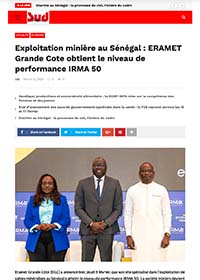
The Chair of Senegal’s National EITI committee

, Thialy Faye, called upon mining companies to adopt the IRMA Standard at a Dakar press conference announcing the IRMA audit of Eramet’s Grand Côte minerals sands operation. He said (quoted in Sud Quotidien),

“[EITI Senegal cmte] are calling on all other companies to commit to [IRMA] standards. IRMA is a voluntary process. It is the company that decides whether to adhere to a certain set of standards and participate in the process.”

dans l’original français:
« Nous lançons un appel à toutes les autres entreprises à se soumettre à ces standards. IRMA, c’est un processus volontaire. C’est l’entreprise qui décide de vouloir respecter un certain nombre de standards et venir se soumettre au processus »
READ MORE
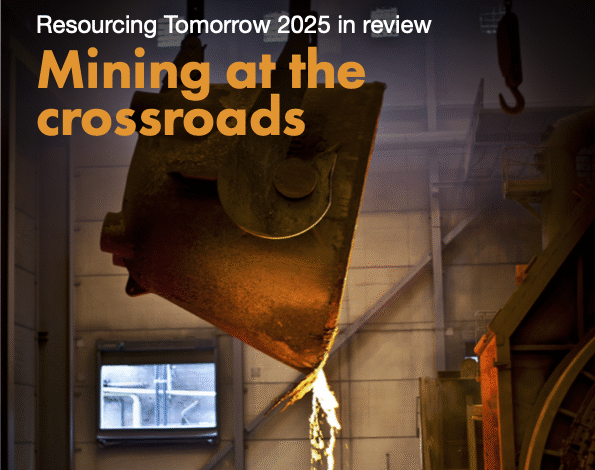
Resourcing Tomorrow 2025 coverResourcing Tomorrow 2025 cover

Global Witness’ Head of Policy and EU Relations, Transition Minerals

, Emily Iona Stewart declared in the Mining Beacon’s Resourcing Tomorrow 2025 in Review: Mining at the crossroads that

“The proliferation of standards isn’t helpful to anybody. As civil society we often point to the IRMA standard as the gold standard because it’s a standard that has been developed alongside civil society, alongside communities and has existed in the operations for a while.”

READ MORE
The Australian Sustainable Finance TaxonomyThe Australian Sustainable Finance Taxonomy

Australian Sustainable Finance Institute

(AFSI) has created the Australian Sustainable Finance Taxonomy to provide a common language for green and transition finance in Australia, to support the allocation of capital towards activities that enable Australia’s net zero ambitions. AFSI is a nonprofit that works to align Australia’s financial system with a sustainable, resilient, and inclusive economy by directing capital towards environmental and social goals.

The Taxonomy references IRMA in two ways: first, as an international proxy for biodiversity and ecosystem protection; and second as a reference for First Nations and cultural heritage protection.

READ MORE
ACK/AKMIN Consent Analysis Report coverACK/AKMIN Consent Analysis Report cover

The Alaska Conservation Foundation (ACF)

commissioned a report “to present the Alaska Mining Impacts Network’s (AKMIN) collective vision of meaningful and equitable consent-based decision-making in mining projects.” The resulting Consent Analysis Report exclusive uses the IRMA Standard as a reference for FPIC in voluntary standards. For example,

“Internationally, UNDRIP clearly establishes FPIC principles […] The Initiative for Responsible Mining Assurance (IRMA) integrates FPIC into voluntary certification standards, setting ethical benchmarks for corporate accountability in mining projects. Together, these frameworks illustrate the varied landscape of consultation and consent, emphasizing the need for clear definitions, strong enforcement, and authentic engagement to protect Indigenous rights and support genuine community decision-making.”

READ MORE
Newsweek oped thumbnailNewsweek oped thumbnail

Earthworks and Human Rights Watch

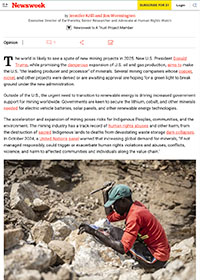
authored an op-ed in Newsweek titled Global Demand for Minerals Requires New Mining Protections.

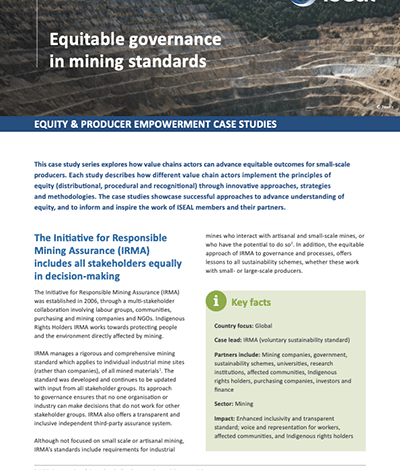
They recognize IRMA as “a voluntary initiative that has synthesized international human rights law and environmental standards into a single document defining responsible mining practices. The strength of [which] is its governance system which gives community representatives, labor unions, and civil society groups equal power, alongside mining companies and the private sector, to craft its standards.

READ MORE
Cover of Mighty Earth and Rainforest Foundation Norway cover for Biodiversity and Deforestation in Mining Standards BriefCover of Mighty Earth and Rainforest Foundation Norway cover for Biodiversity and Deforestation in Mining Standards Brief

Rainforest Foundation Norway and Mighty Earth

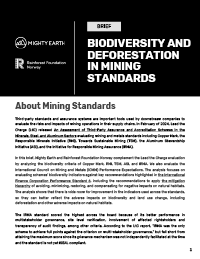
published a brief Biodiversity and Deforestation in Mining Standards.

In comparing the limitations of  IRMA, CopperMark/RMI and TSM to avoid deforestation and minimize impacts on critical ecosystems, they conclude “the IRMA Standard consistently rises above other mining standards for evaluating biodiversity impacts, due to its stronger requirements, multistakeholder governance and transparency, among other criteria. As global mining operations increase, third party auditing will be necessary for ensuring that mining across the world is conducted in a responsible way that upholds human rights and minimizes adverse environmental impacts.”

READ MORE

Public Citizen

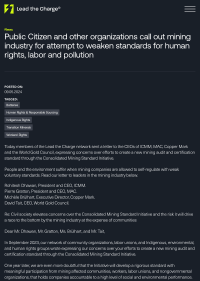
and other organizations sent a letter to the ICMM, CopperMark, the Mining Association of Canada, and the World Gold Council expressing concerns over their Consolidated Mining Standard Initiative.

In doing so they “recognize that strong voluntary standards can help drive improved mining industry human rights and environmental performance if they have the level of transparency and rigor necessary to provide credible information,” and provides criteria that such a standard must meet.

As an example, the letter recognizes only IRMA by name: “There are existing standards, notably IRMA, that meet many of these criteria.”

READ MORE