Asia

Labor

IRMA Secretariat statement re Kostenko tragedy

Statement of Aimee Boulanger, Executive Director of the Initiative for Responsible Mining Assurance (IRMA), regarding the tragic loss of life of 46 mine workers at ArcelorMittal’s Kostenko mine in Kazakhstan on Saturday, 28 October 2023.

ArcelorMittal has served on IRMA’s Board of Directors since 2015.

The heartbreaking disaster at ArcelorMittal’s Kostenko mine weighs heavily on me, our staff, and IRMA board members. IRMA’s vision is a world where the mining industry respects the human rights and aspirations of affected communities; provides safe, healthy and supportive workplaces; minimizes harm to the environment; and leaves positive legacies. Devastating loss of life, such as has occurred in Kazakhstan, brings into sharp focus the urgency of bringing this vision into reality. At too many mine sites around the world, workers labor under unsafe conditions—and this urgently needs to change. IRMA exists to help create this change.

In coming weeks, IRMA’s labor sector leaders will meet with ArcelorMittal representatives. IRMA, as an organization, won’t take a further stance on this issue until informed by the outcomes of conversations between IndustriALL, USW and ArcelorMittal, as these are the organizations best set to make a recommendation to the IRMA Board of Directors.

IRMA is a system seeking to drive more responsible mining practices around the world, responsive to the values of six governing houses, including labor unions, mining companies, NGOs, affected communities, investors and companies who purchase mined materials. These six houses equally govern IRMA’s multistakeholder system.

We extend our deepest sympathies to the families and loved ones of those whose lives were lost at this ArcelorMittal mine site. May our work together prevent future losses of life and ensure greater welfare for people and the lands they rely on.

READ MORE
IRMA ltr to State dept thumbnail 20230127IRMA ltr to State dept thumbnail 20230127Government

Minerals Security Partnership, U.S. should require IRMA

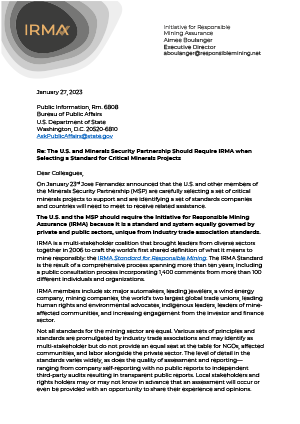
IRMA ltr to State dept thumbnail 20230127
Click to view letter as pdf

Public Information, Rm. 6808
Bureau of Public Affairs
U.S. Department of State
Washington, D.C. 20520-6810
AskPublicAffairs@state.gov

Re: The U.S. and Minerals Security Partnership Should Require IRMA when Selecting a Standard for Critical Minerals Projects

Dear Colleagues,

On January 23rd Jose Fernandez announced that the U.S. and other members of the Minerals Security Partnership (MSP) are carefully selecting a set of critical minerals projects to support and are identifying a set of standards companies and countries will need to meet to receive related assistance.

The U.S. and the MSP should require the Initiative for Responsible Mining Assurance (IRMA) because it is a standard and system equally governed by private and public sectors, unique from industry trade association standards.

IRMA is a multi-stakeholder coalition that brought leaders from diverse sectors together in 2006 to craft the world’s first shared definition of what it means to mine responsibly: the IRMA Standard for Responsible Mining. The IRMA Standard is the result of a comprehensive process spanning more than ten years, including a public consultation process incorporating 1,400 comments from more than 100 different individuals and organizations.

IRMA members include six major automakers, leading jewelers, a wind energy company, mining companies, the world’s two largest global trade unions, leading human rights and environmental advocates, indigenous leaders, leaders of mine-affected communities, and increasing engagement from the investor and finance sector.

Not all standards for the mining sector are equal. Various sets of principles and standards are promulgated by industry trade associations and may identify as multi-stakeholder but do not provide an equal seat at the table for NGOs, affected communities, and labor alongside the private sector. The level of detail in the standards varies widely, as does the quality of assessment and reporting—ranging from company self-reporting with no public reports to independent third-party audits resulting in transparent public reports. Local stakeholders and rights holders may or may not know in advance that an assessment will occur or even be provided with an opportunity to share their experience and opinions.

IRMA stands out from industry trade association standards because it is recognized across stakeholder sectors and has already been recognized by multiple MSP members. The United Kingdom’s 2022 Critical Minerals Strategy references IRMA as a globally recognized framework for responsible mining.[1] In 2021, the White House referenced IRMA in its 100-Day Review on Building Resilient Supply Chains, noting that IRMA is a possible “method for U.S. companies and the Federal Government to ensure that minerals are being sourced from mines with robust environmental, social, and financial responsibility practices.”[2] The European Parliament referenced the IRMA Standard in its 2021 strategy for critical raw materials.[3] The Government of Australia called IRMA a “no regrets approach” in its 2020 study of certifications and strategies to increase competitiveness of Australian battery materials for use in the EV sector in Europe.[4]

IRMA is the only standard for the mining sector that fully embodies the Biden Administration’s environmental justice goals. This is because IRMA is the only standard for the mining sector that:

  • is equally governed by directly affected communities, NGOs, labor unions, mining companies, purchasing companies, and the investor and finance sector;
  • requires public notice in advance of an audit so that local stakeholders and rights holders can prepare to engage in the audit;
  • is applicable globally and covers all mined materials (apart from thermal coal, uranium, and deep seabed mining projects);
  • includes the full range of environmental and social issues related to industrial-scale mines;
  • requires detailed public reports made available at no cost to the public, with scoring and rationale on over 26 topics across over 400 requirements; and
  • has demonstrated credibility with civil society and labor unions.

IRMA is built on best practice norms. Existing international systems and frameworks form the basis of requirements in the IRMA Standard and are assessed in IRMA audits. These include but are not limited to the Extractive Industries Transparency Initiative (EITI), the International Cyanide Management Code, International Finance Corporation (IFC) Performance Standards, International Labour Organization Conventions, International Union for Conservation of Nature (IUCN) Protected Area Management Categories, the Minamata Convention on Mercury, OECD Due Diligence Guidance, UNESCO Biosphere Reserves, the United Nations Guiding Principles on Business and Human Rights, and the Voluntary Principles on Security and Human Rights.

IRMA requires completion of an independent third-party audit before any public claims may be made related to IRMA achievement. The IRMA system enables companies to clearly communicate their performance across a holistic set of best practices and work toward continuous improvement in environmental and social responsibility.

IRMA’s equal governance model upholds a standard and system that creates confidence and value across all stakeholder sectors and greater trust across supply chains. The U.S. and MSP should support and incentivize the IRMA Standard and system because of its unique accountability to all sectors and alignment with the MSP’s commitment to “adhere to the highest environmental, social, and governance standards.”[5]

Sincerely,

Aimee Boulanger signature

Aimee Boulanger,
IRMA Executive Director


[1] United Kingdom Department for Business, Energy & Industrial Strategy, Resilience for the Future: The UK’s Critical Minerals Strategy, July 22, 2022, https://www.gov.uk/government/publications/uk-critical-mineral-strategy/resilience-for-the-future-the-uks-critical-minerals-strategy.

[2] The White House, Building Resilient Supply Chains, Revitalizing American Manufacturing, and Fostering Broad-Based Growth: 100-Day Reviews Under Executive Order 14017, June 2021, https://www.whitehouse.gov/wp-content/uploads/2021/06/100-day-supply-chain-review-report.pdf.

[3] European Parliament, A European Strategy for Critical Raw Materials, November 24, 2021, https://www.europarl.europa.eu/doceo/document/TA-9-2021-0468_EN.html.

[4] UTS Institute for Sustainable Futures and the University of Melbourne, Certification and LCA of Australian Batter Materials – Drivers and Options: Scene Setting Project Prepared for Future Battery Industries CRC, Future Battery Industries CRC, Australian Government Department of Industry, Innovation and Science Business Cooperative Research Centres Program, August 2020, https://fbicrc.com.au/wp-content/uploads/2020/10/Certification-of-Au-Battery-Materials-WEB-INTERACTIVE-SEPT-2020.pdf.

[5] U.S. Department of State, Minerals Security Partnership, June 14, 2022, https://www.state.gov/minerals-security-partnership/.

READ MORE
Flag of IndonesiaFlag of IndonesiaGovernment

Engaging Indonesia

At the invitation of Indonesia’s Coordinating Ministry for Maritime and Investment Affairs, IRMA participated in a series of meetings held September 5-9 in Jakarta to introduce the IRMA Standard and system to a wide range of sectors with interest in mineral development and processing. Represented by Senior Policy Advisor Kristi Disney Bruckner, the meetings occurred following requests from members of IRMA’s Buyers Group for engagement in Indonesia, calling on mine sites to complete independent, third-party audits.

Indonesia’s Coordinating Ministry for Maritime and Investment Affairs, EITI Indonesia, Eramet, and others collaborated to host a full-day Introducing the Initiative for Responsible Mining Assurance (IRMA) to Indonesian Mining Companies forum on September 6th. Over 140 participants attended the event, including representatives of more than 25 companies with experience in nickel, aluminum, steel, coal, and other sectors. Participants also included representatives of the Ministry of Energy and Mineral Resources, Environment and Forestry, Finance, and Investment; the National Standardization Agency; state-owned enterprises; French and U.S. Embassies; and NGOs Publish What You Pay, Action for Ecology and People Emancipation (AEER), and others; media; consultants; academics; investors; and purchasing companies. Speakers at the event included representatives of Eramet, IRMA, the Coordinating Ministry for Maritime and Investment Affairs, the EITI Secretariat, and Ørsted.

Screenshot of Forum: Introducing the Initiative for Responsible Mining Assurance (IRMA)

IRMA participated in a separate NGO Roundtable on September 7th, attended by Publish What You Pay, Keanekaragaman Hayati (Indonesian Biodiversity Foundation), Yayasan Konservasi Alam Nusantara (Indonesian Nature Conservation Foundation, YKAN), Auriga Nusantara, World Resources Indonesia, Peduli Konservasi Alam (Movement for Nature Conservation, PEKI), Konservasi Indonesia (Conservation Indonesia), Wetlands International Indonesia, and AEER.

IRMA also held ad hoc meetings throughout the week with representatives of NGOs, government, and companies.

Indonesia is a major producer of nickel and other materials needed for EVs and is key to the energy transition. The recent history of mining in Indonesia includes environmental harm and human rights violations, particularly in Papua Province. Addressing those harms, preventing future harm, and ensuring equitable distribution of benefits requires responsible management of the mining sector. 

The Indonesian government’s invitation and its completion of a gap analysis between the country’s legal framework and the IRMA Standard for Responsible Mining signal recognition of the IRMA Standard as a model to capture the increasing market value of environmental and social responsibility. IRMA is a tool available to all Indonesian stakeholders–government, NGOs, affected communities, organized labor, mining companies, purchasing companies, and investors–to promote more responsible environmental and social management in the mining sector. IRMA’s engagement in Indonesia supports efforts to improve governance of the mining sector and bring Indonesian mines into  IRMA’s independent, third-party audit and transparent reporting process. These steps can promote good governance from national to mine site levels, benefitting diverse stakeholders and rights holders in Indonesia.

READ MORE
Mining

China, e-silk roads and a plea for change

The EV revolution is in its infancy, but it is gaining traction, and its minerals, whatever they are, will have to be mined responsibly.  

Author, John Harker


What if China, the EU, and North America co-operated to undertake a major survey of Responsible Mining and Rare-Earths? A survey in which major mining houses such as BHP, Glencore, and Anglo-American would have much to offer, especially as they are increasing or refining their own focus on “battery” minerals.

In fact, their involvement is key. They know the ups and downs in mining as the EV revolution unfolds. A year ago, Ivan Glasenberg, the CEO of Glencore, stressed that his company has “a key role to play in enabling the transition to a low-carbon economy”. This is true, but the company has seen its profits drop due in large part to its “battery minerals” business.

Anglo-American is the world’s largest supplier of platinum and palladium, which are essential to the smooth running of cars fueled by Petrol/Gas, and the company is now intent on developing a lithium battery which will use the platinum-group metals instead of cobalt and nickel.

The great mining houses are among the companies which created the Initiative for Responsible Mining Assurance, a body which would also be a source of strength for any such survey.

Read the full article on Mining.com >

Photo credit: Electric taxi in Shenzhen, China. (Image: Brücke-Osteuropa | Wikimedia Commons.)

READ MORE
  • 1
  • 2