supply chains

Chain of Custody Standard

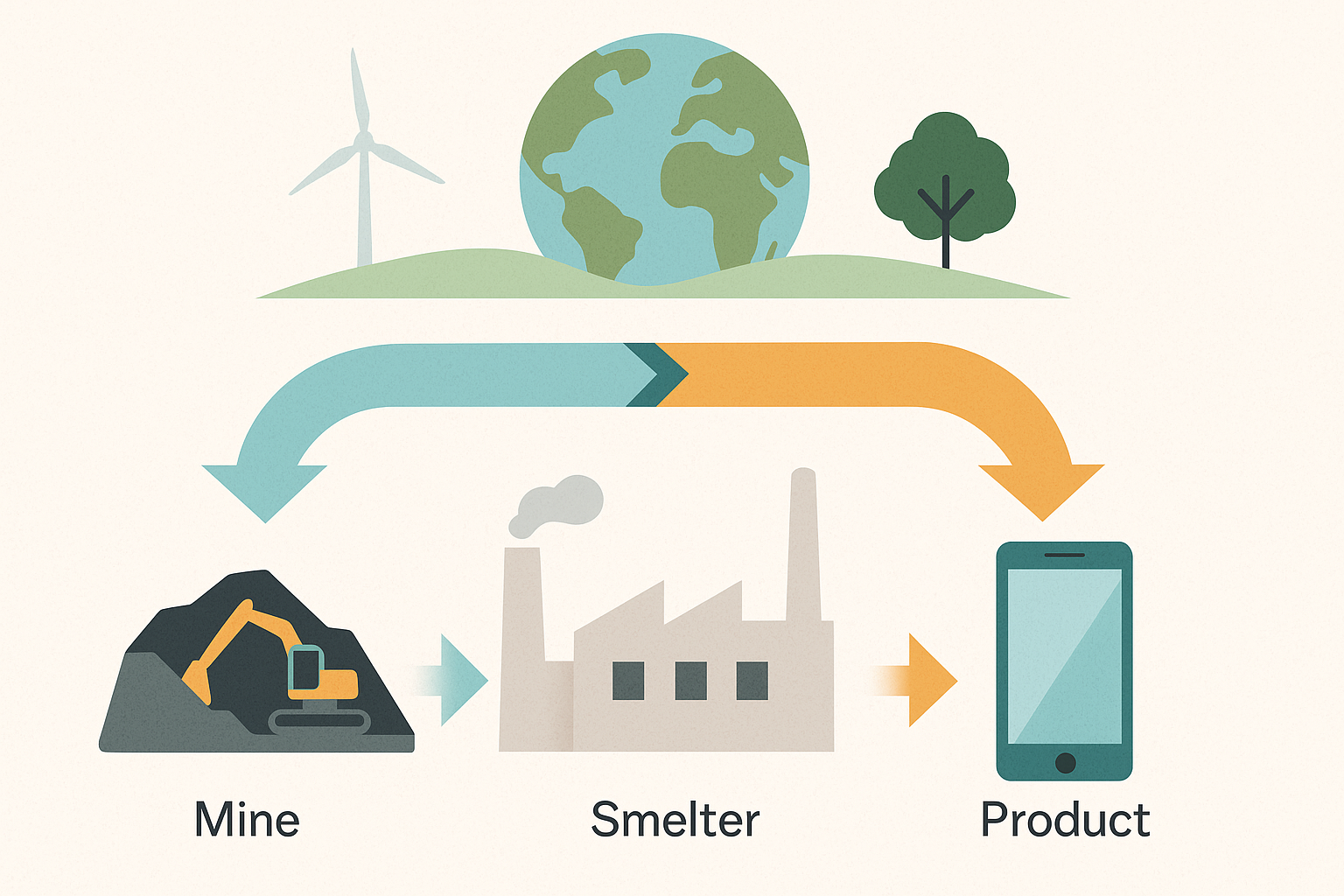
From Mine to Market and Source to Store: Why IRMA’s Chain of Custody Standard Matters

Minerals power the modern world, from the batteries that drive electric vehicles to the metals in wind turbines, phones, and medical equipment. But as demand increases, so does the pressure to ensure these materials are sourced responsibly.

IRMA’s independent, community- and worker-centered mine-site audits address one part of this challenge: verifying responsible practices at the mine itself. Yet for many companies and consumers, a key question remains:

How do we know the minerals in a finished product actually came from an IRMA-assessed mine?

The answer lies in a chain of custody. IRMA’s Chain of Custody (CoC) Standard, launched in 2024, is designed to carry trust beyond the mine and into the complex networks of processors, refiners, manufacturers, and brands.

Why Chain of Custody Is Essential

Once minerals leave the mine, they often enter global systems where materials are blended, transformed, or routed through multiple facilities. A CoC standard closes this gap by enabling companies to make verifiable sourcing claims linked directly to IRMA-audited mines. As transparency becomes a regulatory expectation and a growing consumer demand, this link is more important than ever.

New EU rules, including the Critical Raw Materials Act and the 2025 mineral-supply-chain transparency platform, signal that traceability is rapidly shifting from a voluntary gesture to a regulatory requirement. Companies importing or using critical minerals will increasingly need credible systems to demonstrate where materials come from and how they manage associated risks.

Recent New York Times reporting also highlights the human cost of opaque supply chains, documenting how recycled battery lead has poisoned communities. It is a stark reminder that reliable chain-of-custody systems like IRMA’s are no longer optional but essential.

A Step Toward More Transparent Minerals

The IRMA CoC Standard outlines five models, a flexible structure that meets companies where they are while maintaining transparency and credibility:

Identity Preserved: Minerals stay physically separate and traceable from mine to final product.

Segregated: IRMA-assured materials from different mines can be mixed, but never combined with non-assured material.

Controlled Blending: Allows mixing with non-assured material while maintaining clear controls and limits.

Mass Balance: Tracks inputs and outputs over time, offering flexibility where physical separation is not possible.

Book & Claim: A credit-based model enabling support for responsible mining even when physical traceability is highly complex.

Together, these models give companies flexibility in how they track materials, and the pilots now underway are helping IRMA understand which approaches work best across different supply-chain contexts.

Next Steps for IRMA

IRMA has developed and published the Chain of Custody Standard, including guidance on assurance and on how the IRMA seal enables credible, transparent claims about responsibly sourced materials. Building on this foundation, IRMA has launched pilots across different mineral sectors and industries to test how the CoC models work in practice and what companies need for effective implementation. As these pilots progress, IRMA is now working to formalize the resulting data into a materials registry that will allow participating companies to make verified chain-of-custody claims with confidence.

Piloting the CoC Standard with mining companies, processors, and downstream buyers to test feasibility across different supply-chain contexts.

Integrating feedback from pilot participants, auditors, and technical experts to strengthen clarity and usability.

Creating tools and templates that support consistent data collection and transparent sourcing claims.

The chain of custody alone cannot solve every supply-chain challenge. But it plays a crucial role in linking responsible mining practices with the products people rely on every day. It supports stronger procurement decisions, clearer consumer communication, and more consistent accountability across the value chain. These efforts mark real progress toward knowing where your phone battery comes from—from mine to market, and source to store.

If your company would like to join the brands already piloting the IRMA CoC Standard and explore how it could work in your supply chain, I’d welcome a conversation! Feel free to reach out.


coc@responsiblemining.net

READ MORE
Oxidated copperOxidated copperBlog

ClimateWorks: Center Communities to Build Responsible Supply Chains

Below is an excerpt of a ClimateWorks blog by Lina Fedirko. Read the full version on their site.

The energy transition presents a unique opportunity to reshape mineral supply dynamics so that mining contributes to resilient, prosperous, and healthy communities. However, Indigenous Peoples and communities around the world have suffered from the consequences of irresponsible mining, such as deepening inequality, rising conflicts, and environmental degradation. A responsible mineral supply chain is necessary to help rebuild broken trust and ensure the energy transition does not replicate unjust and exploitative mining practices.

At ClimateWorks, we are actively seeking the insights and aspirations of our local partners around the globe to shape our collective effort to build a responsible mineral supply. Recently, I spoke with two regional leaders — Davidzo Muchawaya based in South Africa, and Pochoy P. Labog based in Indonesia — to gain their unique perspectives on the legacy of mining and their hopes for the clean energy transition.

Davidzo is the Africa Regional Lead for the Initiative for Responsible Mining Assurance (IRMA), an organization that sets a globally recognized, rigorous, and best practice standard for the mining industry. Pochoy is the Southeast Asia Researcher and Representative with the Business and Human Rights Resource Centre (BHRRC), which monitors the human rights impacts of more than 10,000 companies worldwide.

What is your organization’s role within the broader ecosystem of organizations working on minerals in your regions? How do you collaborate?

Davidzo Muchawaya: IRMA is three things. It is a voluntary best practice mining standards and a process for independently measuring mines’ performance against that standard. It is also an organization overseeing the standard and measurement processes with representatives of affected stakeholder groups equally governing us: mining, purchasers, finance, organized labor, advocacy NGOs, impacted communities, and Indigenous rights holders. IRMA’s contribution to broader collaboration stems from our focus on capacity building among our stakeholders to help them better understand how to use our tools. We engage stakeholders, including the BHRRC, through regular outreach about engagement on mining issues and upcoming audits.

As a regional lead in Africa, I engage with civic organizations, impacted communities, organized labor, and other groups and regularly solicit feedback on our audit system and tools. IRMA’s vision is a world where the mining industry respects human rights, provides safe and healthy working conditions, minimizes environmental harm, and leaves positive legacies.

Read the full interview with Davidzo and Pochoy on the ClimateWorks website.

READ MORE
ISO logoISO logoGovernment

“Sustainable Critical Minerals Supply Chains” ISO Workshop

Share Your Experience: ISO Workshop on “Sustainable Critical Minerals Supply Chains” 16-17 April, New York City

RSVP with ISO for Virtual or In-Person Participation

IRMA is participating in a series of International Organization for Standardization (ISO) International Workshop Agreement (IWA) 45 sessions focused on “sustainable critical minerals supply chains.” ISO welcomes you to share your experience at the second session of IWA 45 this 16-17 April.

The series, hosted by Standards Australia, explores sustainability tools, guides, and frameworks available to “assist in improving an organization’s sustainability outcomes.” Following a first in-person only session held in Tokyo, Japan, the second IWA 45 session aims to broaden stakeholder engagement, including by enabling both in-person and virtual participation in the New York City session.

The IWA 45 series is important as it will inform the work of the ISO and the national standards bodies of its member countries, including, for example, work under ISO/PC 348 to specify criteria for sustainable raw materials from extraction to final product manufacturing.


For More Information:

READ MORE
Credit: Dick Thomas Johnson-CCBY2.0Credit: Dick Thomas Johnson-CCBY2.0Government

ISO, responsible mining, and multi-stakeholder engagement

As the ISO takes on important work on responsible mining, IRMA restates the importance of inclusive and meaningful multi-stakeholder engagement

On 15-16 February 2024 in Tokyo, Japan, IRMA participated in the first working session of the ISO IWA 45, an international working agreement on “sustainable critical mineral supply chains.” This project is led by Standards Australia (Australia’s national standardization body) under the auspices of the International Organization for Standardization (ISO) and is tasked to “understand the range of sustainability tools/guides/frameworks available which will assist in improving an organization’s sustainability outcomes.” ISO is a quasi-governmental organization dedicated to standard development, headquartered in Switzerland and composed of the national standards bodies of its member countries.

This workshop was an in-person-only event which, while providing constructive opportunity for people to connect directly, dramatically reduced the number and diversity of stakeholders affected by mining and mineral value chains to participate. There were about 45 participants, with a majority from industry (mining and mineral processing) and consultants to the private sector, followed by government delegations (including national standardization bodies and state agencies or research institutions). The most represented countries were the United States, Canada, China, and Japan.

Articulating the perspectives of our members from six houses—affected communities, downstream purchasers, investment and finance, mining industry, NGOs, and organized labor—IRMA worked actively in the session to integrate the perspectives of civil society and organized labor, as those groups were not in attendance. We are concerned about how their absence might leave a significant gap in this process and encourage the event organizers to increase this outreach.

The working session opened with a summary of the results obtained from a preliminary survey circulated by Standards Australia in January 2024. Of the 115 full responses received, two-thirds came from the mining and mineral processing industry, 7% from NGOs, and 7% from academia. Most of the responses originated from China and Canada (over 10%), followed by the U.S., the United Kingdom, Australia, Japan, Germany, South Africa, and Sweden; other countries were all under 3%.

Given the survey feedback was foremost from industry, the main insights shared by the workshop organizer reflected the positions of industry representatives who engaged in the survey, including the “proliferation,” “overlap,” and “inefficiency” of sustainability standards, the “confusion” they would create, and the “burden” created by assurance mechanisms that would be “significant, costly, and time-consuming”.

It is worth noting that IRMA has never heard civil society or mine workers complain that “assurance processes are too expensive,” but rather that they see need for increased investment in transparent sharing of information on performance and for improved practices. We hope that Standards Australia will be able to soon provide a breakdown of the responses by stakeholder groups and increase outreach to civil society, Indigenous rights holders, and labor leaders.

IRMA emphasized throughout the workshop the importance of inclusive and meaningful multi-stakeholder engagement for ISO to ensure robustness and credibility in its processes and its efforts to standardize responsible business practice. A number of other participants similarly asked for more proactive and targeted outreach to all stakeholder groups. The issue of inclusive and meaningful multi-stakeholder engagement was then selected by the organizer as the final topic for plenary discussion.

As currently designed, IWA and ISO processes, including IWA 45, are not inclusive for affected communities, NGOs, and organized labor, and do not allow for meaningful multi-stakeholder engagement. We ask that this fundamental gap be identified as the top priority in the final report that will be produced by Standards Australia this year, including as a key recommendation to inform the other ongoing ISO committees and workstreams on responsible mining and sustainable mineral value chains.


Photo credit: Dick Thomas Johnson CCBY2.0

READ MORE
U.S. State Department logoU.S. State Department logoGovernment

IRMA presents to the U.S. State Department

Today IRMA executive director Aimee Boulanger, and senior policy advisor Kristi Disney Bruckner presented before the Department of State’s Clean Energy Resources Advisory Committee (CERAC). CERAC “advises the Department of State’s Bureau of Energy Resources on strategies, programs, and policies related to clean energy mineral supply chains.”

IRMA made nine recommendations to CERAC:

  1. Recognize the importance of equal governance in multi-stakeholder leadership, engagement, and public access to information.
  2. Adopt a holistic lens to mining sector management, including a wide range of environmental and social factors.
  3. Use the IRMA Standard for Responsible Mining to assess gaps in domestic legal frameworks, and incorporate best practices on international to local levels.
  4. Promote an inclusive, participatory, transparent rights-based approach to relationships between mines and communities, with access to remedy.
  5. Use IRMA standards and audit reports to guide more responsible sourcing of mined materials.
  6. Encourage mines to engage in IRMA, which connects market value with environmental and social responsibility, and encourages continuing improvement while striving toward best practice.
  7. Identify and act on opportunities for the U.S. to be a “first mover” on responsible sourcing of mined materials, due diligence, and circularity.
  8. Foster innovation, strategic planning, and meaningful engagement of workers, communities, NGOs, companies, and investors in the “green” transition
  9. Collaborate with other governments to enhance environmental and social performance and transparency of the mining sector and supply chains.
READ MORE
Blog

IRMA cited in White House report on building resilient supply chains

We are pleased to share that the U.S. White House mentions IRMA in their recent report from Biden’s Executive Order on building resilient supply chains. Both the U.S. Department of Energy and the U.S. Department of Defense reference the IRMA Standard as a road map for best practices in mining materials needed for large capacity batteries related to renewable energy and for critical minerals related to electronics and mobility:

“The Initiative for Responsible Mining Assurance (IRMA) is an international coalition of businesses, nongovernmental organizations, labor unions, mining operators, and other stakeholders that has developed a Standard for Responsible Mining and established a system for independently certifying mines worldwide that adhere to that standard. IRMA may provide a method for U.S. companies and the Federal Government to ensure that minerals are being sourced from mines with robust environmental, social, and financial responsibility policies, and also could provide a model for responsible development of additional mines in the United States.”

With a measurement model built on social responsibility, environmental responsibility, business integrity and planning for positive legacies, a governance model founded on consensus across multi-stakeholder interests, and a reporting model capturing unprecedented detail while prioritizing transparency, IRMA provides the most credible assurance standard for the mining industry. As recognized by the Biden Administration, IRMA’s standard can inform and provide a template for improved laws and regulations for mines developed in the United States (and elsewhere), and IRMA’s independent assurance program can help to recognize and foster more responsible mineral supply chains globally.

This important recognition is thanks to the commitment and years of collaborative work invested by IRMA’s visionary multi-stakeholder board.

FOR MORE INFORMATION:

READ MORE